
We have launched the Worker Ownership Cities program to accelerate the national adoption of worker ownership by local governments.
There are over 19,500 cities, towns, and villages in the US and less than 1% include worker ownership in their policies or plans. Despite proven benefits, few cities are aware of how they can deploy employee ownership strategies to address local priorities.
Worker cooperatives and other employee-owned business forms have a long track record of meeting needs of workers and small businesses. Studies have shown that worker-owned businesses are more resilient than traditional firms, have higher productivity, and often exceed industry standards, offering better pay and safer working conditions.
The opportunity and the need for worker ownership is clear and growing but many cities don’t have the tools, time, and support they need to adequately improve legacy business retention, job quality and widening income and wealth gaps.
Worker Ownership Cities make it easier for cities to implement high impact, cost-effective employee ownership solutions to their most pressing economic and workforce challenges.
Our program includes:
- Worker Ownership Cities Technical Assistance Cohort
- Worker Ownership Cities Network
How we have worked with local governments
Democracy at Work Institute (DAWI) approaches worker ownership as a tool for broader social and economic aims – strong local economies, secure livelihoods, worker power, racial equity, and community wealth.
We embed support for innovative and equity-focused worker ownership approaches in institutions of power, like government.
Since our founding in 2013, DAWI has worked with municipal governments to develop, implement, and institutionalize policies and programs that strengthen local worker ownership ecosystems.
DAWI is a founding member of the NYC Worker Cooperative Business Development Initiative, the nation’s first large-scale city-funded initiative to support worker ownership and in 2021, we co-developed the Owner to Owners Initiative with the City of New York and national experts in employee ownership transition technical assistance, business outreach communications, and financing.
From 2018 to 2021, we partnered with the National League of Cities to produce the Shared Equity in Economic Development Fellowship (SEED), where teams of city officials and community partners used worker ownership in their communities as an equitable economic development strategy. We co-produced resources and webinars to help city officials identify a worker ownership solution that meets community needs.
Our participants included: Atlanta, Durham, Louisville, Miami, Philadelphia, Richmond, VA, San Francisco, Washington D.C.
DAWI has consulted or partnered directly with local governments to implement their worker ownership goals. These include: Boston, Brockton, Chicago, County of Los Angeles, Nashville, Redwood City, Santa Clara, San Diego, San José, and Seattle.
Worker Ownership Technical Assistance Cohort
Our Worker Ownership Cities Technical Assistance Cohort invites cities and employee ownership experts to partner on developing and driving local projects that increase access to worker ownership for low-wage workers locked out of good jobs and business ownership opportunities. Participating cities benefit from hands-on technical assistance and a national network that implements worker ownership, accelerates place-based learning, and addresses systemic economic barriers.
Our 2026-2027 cohort develops and implements legacy business preservation campaigns that make it easier for business owners seeking to retire or grow their businesses to sell to their employees as their succession or growth strategy.
With almost 50% of small businesses owned by people of retirement age, 80% of whom will be unable to find a buyer, potential business closures will deaden main streets and make good jobs harder to find, especially for workers of color. For many business owners, employee ownership may be their most viable exit plan. The workers whose jobs are at stake may be the most motivated and best positioned to keep the business going. With the right expertise and guidance, cities can take action to promote and incentivize the transition of companies to employee ownership. In doing so, they can save businesses and jobs, and offer workers an opportunity to improve incomes and build wealth, all while deepening local ownership and making their economies more equitable and resilient in the process.
Our 2026-2027 cohort works with:
- City of Raleigh, North Carolina
- City of Durham, North Carolina
Together with trusted local technical assistance partners including the North Carolina Employee Ownership Center, we are making employee ownership a real option for small business owners planning retirement or transition. By expanding access to employee ownership, we are preserving local jobs, strengthening neighborhoods, and building community wealth—one business at a time.
City of Raleigh
Raleigh, North Carolina is known as a vibrant center for technology and innovation. With more than 26,000 small businesses making the city their home, it is vital that we support locally-owned businesses that are at risk of closure to learn how employee ownership can help owners retire, preserve jobs, and support business continuity.
“Raleigh’s small and legacy businesses are the backbone of our community and a major force behind our growth as a vibrant regional hub. Employee ownership opens the door to keeping these businesses locally rooted as they plan for the future. Our partnership with DAWI and NCEOC creates clear pathways for owners and workers to share in long-term success while ensuring the businesses that shaped Raleigh’s past can continue to shape its future.”
-Mark Weldon, City of Raleigh Small Business Development Manager
City of Durham

The City of Durham, NC is working to preserve its legacy businesses and expand small business ownership through transitions to employee ownership. In June of 2018, the City of Durham adopted a new Strategic Plan with a core principle of Shared Economic Prosperity. Their focus is to connect their most vulnerable residents to the growing Durham economy. Removing barriers that limit access to the economy and supporting the retention and expansion of local small businesses are essential focuses of their strategy.
Durham has a rich tradition and history of “Black Wall Street”, which has generated iconic Black-owned companies in the fields of insurance and finance. The City of Durham is looking to preserve and build on the legacy of this rich entrepreneurial tradition.
DAWI first partnered with the City of Durham in 2018 when Durham was one of four cities selected for the inaugural Shared Equity in Economic Development Fellowship. As a result of our partnership, the City of Durham conducted the city’s first ever small business survey to target outreach and provided seed funding for the development of the North Carolina Employee Ownership Center, recognizing that a strong state center could assist in business outreach, education and technical assistance locally.
Click here to learn more about how Worker Ownership Cities program works:
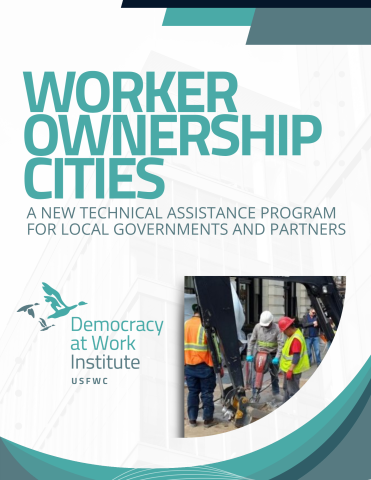
Launching early 2026: Worker Ownership Cities Network
The Worker Ownership Cities Network is a community of practice for all local government leaders seeking to learn how to use employee ownership to strengthen their cities or integrate best practices and lessons learned from peer-led initiatives to inform and improve their existing worker ownership strategies.
In early 2026, we are inviting cities to join the Worker Ownership Cities Network.
Interested in learning more about Worker Ownership Cities? Please let us know here.
For more information contact:
Zen Trenholm, Senior Director of Employee Ownership Cities and Policy at ztrenholm@institute.coop or
Frank Cetera, Director of Business Transfers Program at fcetera@institute.coop
Partners:



Resources:
Tools for Business Owners
Becoming Employee Owned Brief for NC (DAWI 2025)
Employee Ownership Conversion Overview (DAWI)
Tools for Cities
Economic Recovery and Employee Ownership (DAWI/National League of Cities 2021)
The Municipal Playbook for Employee Ownership (DAWI/National League of Cities 2021)
Tools for Advocates:
Cooperative Growth Ecosystem Framework (DAWI/Project Equity 2015)
Ecosystem Assessment (DAWI 2016)
General Employee Ownership Information 2023 Worker Coop Census (DAWI/USFWC 2024)