New City Initiative to Keep Raleigh businesses in Raleigh and Build Community Wealth
Raleigh, NC — Long-standing, locally owned businesses are critical to local economies. To support their longevity, we joined forces with the City of Raleigh and the North Carolina Employee Ownership Center (NCEOC) to launch Employee Ownership Raleigh, a year-long initiative that promotes employee ownership as a strategy for business continuity.
NCEOC serves as the primary technical assistance provider, while the City and the Democracy at Work Institute (DAWI) will raise awareness and develop infrastructure to connect business owners to ownership transition support.
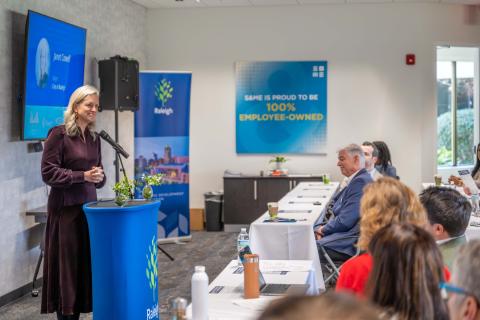
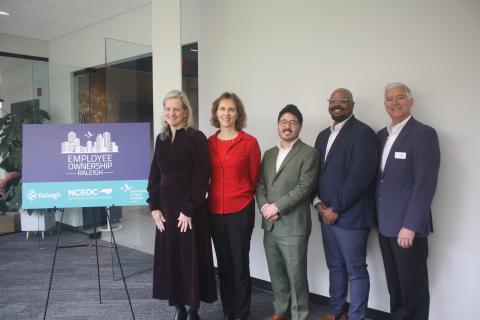
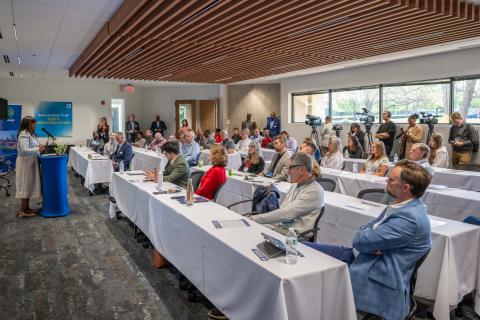
Raleigh Mayor Janet Cowell joined NCEOC and DAWI for a formal announcement at S&ME, a 100% employee-owned company. Representing the breadth of partnerships supporting Employee Ownership Raleigh were Stewart Laney, CEO at S&ME; James Watts, General Manager at Weaver Street Food Co-op, and Dr. Darlene Deberry of UNC-Chapel Hill’s NCGrowth.
Raleigh has over 26,000 small businesses, and more than 50% of American business owners are 55 or older. But only 30% of business owners have a clear succession plan. This leaves many small businesses at risk of closure once owners retire. For decades, businesses of various sizes have used employee ownership to preserve and build business legacies, local jobs, and community wealth. Employee Ownership Raleigh will highlight three primary employee ownership models:
- Employee Stock Ownership Plans (ESOPs): Benefit plans that allow employees to own shares of the company stock.
- Employee Ownership Trusts (EOTs): A more flexible, perpetual trust model for long-term employee benefit.
- Worker Cooperatives: Businesses owned and democratically controlled by their members.
Business owners interested in exploring these options can request free, confidential guidance and one-on-one counseling through NCEOC’s online portal. Advisors will help owners identify the model that best aligns with their business goals and desired timeline. As the program moves forward, the City will promote the initiative to its mailing list of over 8,000 small businesses, support partner outreach, and coordinate data sharing on employee ownership conversions with NCEOC. These efforts will ensure local businesses have access to education and guidance on succession planning and ownership transition options.
The initiative will run through the end of 2026, with long-term resources remaining available after the campaign. NCEOC will continue offering local and statewide technical assistance, and NCEOC and DAWI will continue monitoring employee ownership transitions. The City will continue sharing resources and impact data in its free resources for businesses, monthly newsletters, and monthly meetings with over 20 local business alliances and partners. These efforts will continue to build awareness and understanding of employee ownership in Raleigh’s business community.
“Raleigh’s small and legacy businesses are the backbone of our community and a major force behind our growth as a vibrant regional hub,” said Mark Weldon, the City of Raleigh’s Small Business Development Manager. “Employee ownership opens the door to keeping these businesses locally rooted as they plan for the future.”
“Employee ownership creates a win-win-win for business owners, employees, and communities,” according to Illa Burbank, Executive Director of NCEOC.
“For business owners, it's a lasting tribute to their dedication, ensuring the businesses they poured their hearts into continue to thrive and maintain their legacy for generations to come. For our employees and communities, employee ownership champions the protection of local jobs, anchors vital businesses firmly in their neighborhoods, and fuels a more vibrant and prosperous local economy,” said Illa Burbank.
Employee Ownership Raleigh is made possible through philanthropic support from the Beyster Foundation for Enterprise Development and the Nathan Cummings Foundation. Through this initiative, the City of Raleigh joins DAWI’s Employee Ownership Cities program, a growing network of U.S. municipalities expanding employee ownership to create more resilient local economies, quality jobs, and wealth for workers.
“We are excited to partner with the City of Raleigh and the North Carolina Employee Ownership Center in making employee ownership an accessible option for small business owners planning retirement or transition,” said Zen Trenholm, DAWI’s Senior Director of Employee Ownership Cities and Policy.