
Every city has businesses that feel like its heartbeat: the ice cream parlor where the employees know every customer by name, the local manufacturer that anchored a neighborhood for decades, or the trade shop that kept generations of workers employed. But when those owners reach retirement, the traditional options are not enough. Without a family heir or an outside buyer, many beloved small businesses simply close shop. Jobs vanish, spaces sit vacant, and the local economy loses another pillar.
The City of Cincinnati and Hamilton County are now taking a decisive step to rewrite that story, alongside Co-op Cincy, they are officially joining the Democracy at Work Institute’s (DAWI) Employee Ownership Cities network.
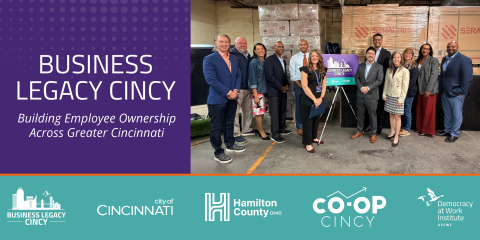
Following the blueprint established by Raleigh and Durham in North Carolina, Cincinnati and Hamilton County are embedding worker ownership transitions directly into their economic development strategies. The initiative focuses on helping business owners sell their companies to the very people who helped build them, using proven models like worker cooperatives, Employee Ownership Trusts (EOTs), and Employee Stock Ownership Plans (ESOPs).
The economic case for this intervention is urgent. National data shows that roughly 30% of small businesses successfully pass to family members, and only about 20% are sold on the open market. That leaves half of all established small businesses facing closure simply for lack of a succession plan, this is a silent drain on local economies often described as the "silver tsunami."
By stepping in with formal municipal support, Cincinnati and Hamilton County are treating business retention as a frontline economic issue. Transforming long-time employees into business owners does more than keep doors open; it shifts workers from earning hourly wages to holding actual equity, creating a tangible pathway to generational wealth in communities that need it most.
A coalition of public officials and ground-level champions made this launch possible. Leadership from Cincinnati Mayor Aftab Pureval, Vice Mayor Jan-Michele Lemon Kearney, and Hamilton County Commissioner Denise Driehaus provided the civic momentum needed to align local policy with economic reality. Alongside Department of Opportunity and Resident Services Director Markiea Carter, public leadership is ensuring that local business preservation remains a citywide priority.
Crucially, the success of municipal policy relies on grassroots technical expertise. DAWI’s partnership with community leaders including Ellen Vera, Kristen Barker, Meghan Elizabeth, Candace Winterbauer, and Sidney Cherie Hilley from Co-op Cincy, gives local owners the hands-on advisory support and financial structuring needed to navigate ownership transitions with confidence.
By uniting city and county government in a shared regional strategy, Greater Cincinnati is setting a national precedent for how local leadership can safeguard its economic base.
For business advisors, community advocates, and local leaders in the Cincy metro area, spreading the word is the vital next step. You can explore DAWI’s Employee Ownership Cities Network to see the national framework, share the Cincinnati Campaign Page with local business owners considering retirement, or check out the recent local news coverage highlighting how worker-owners across the region are already sharing in the profits of their labor.